Local vs Regional vs Global eSIM: Which Sim Local Plan Should You Choose?
The biggest travel eSIM is not automatically the smartest purchase. A worldwide package can be useful for a complicated itinerary, but it may add little value to a holiday spent entirely in one country.
Explore the guide
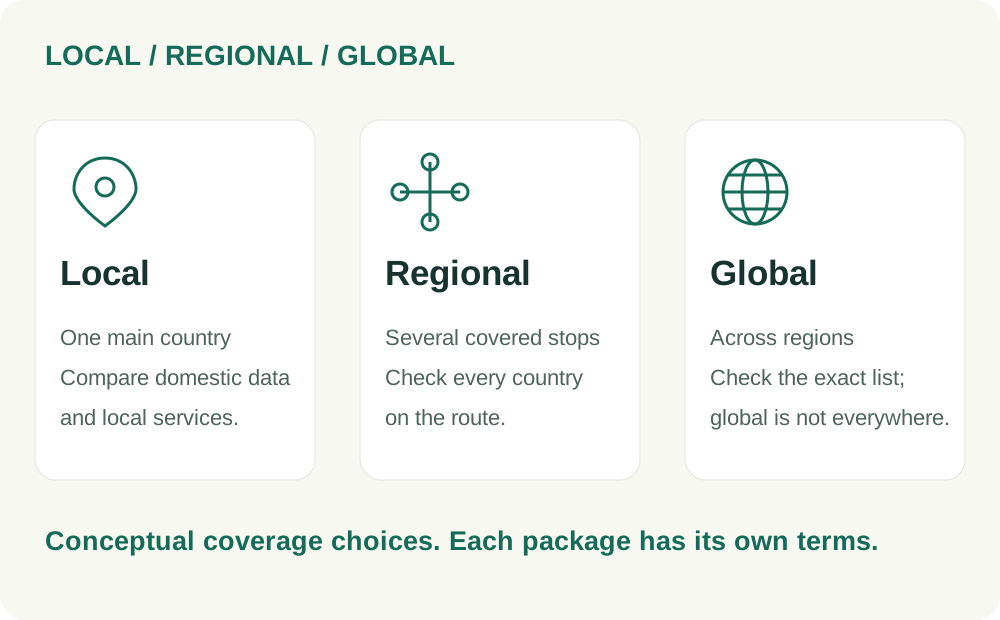
Local, regional, and global eSIMs describe different coverage choices. The right one depends on where you need service, how long you will stay, and which communication features matter to you.
For a simple trip, start with the destination itself. For several neighbouring countries, compare a regional package. For travel across multiple regions, a global plan deserves a closer look.
Sim Local offers options across these categories, including operator products and data-focused travel packages. This guide explains how to compare them without confusing country counts, roaming allowances, or the word local.
Affiliate disclosure: We may earn a commission when you purchase through our links, at no extra cost to you.
What Is a Local eSIM?
In travel shopping, a local eSIM often means a package sold for use in one country. A Japan eSIM, for example, is aimed at someone who needs connectivity in Japan.
The practical benefit is focus. You can compare the data, duration, network, and services for the destination where you will spend your time, without paying for a broader itinerary you do not have.
However, the word local has another meaning: a plan issued by a domestic operator. Those two meanings should not be treated as identical.
A single-country travel product may still use roaming arrangements behind the scenes. Being sold for one country does not, by itself, establish a local phone number, domestic network priority, or a particular internet-routing path.
Look at the actual provider and package features. If native calling or a local number is important, choose a product that explicitly includes it instead of relying on the destination name.
What Is a Regional eSIM?
A regional eSIM covers a defined group of countries. Europe, Asia, and North America are common shopping categories, although each provider decides which destinations belong to its particular product.
The main benefit is continuity. If all your stops are included, you can use one installed profile and one package while moving between those countries.
That can be convenient on a rail holiday, multi-city work trip, or route with several short stays. You spend less time buying connectivity after each border crossing.
The coverage list is the deciding detail. Two packages called Europe can include different countries, and a regional plan should never be assumed to cover every destination in the wider geographic region.
Read the data conditions too. Many regional products provide a shared allowance across included countries, but the exact package determines whether there are country-specific restrictions or separate buckets.
What Is a Global eSIM?
A global eSIM covers a broader list of destinations, often across several regions. It is designed for an itinerary that cannot be handled neatly by a single-country or one-region product.
The convenience can be substantial. Someone travelling between Europe, Asia, and North America may prefer managing one suitable package instead of several separate purchases.
Global does not mean every country on Earth. It means the destinations named in that product's coverage list, under its stated conditions.
A provider's overall catalogue can also be larger than the coverage of its global package. The fact that a company sells a country-specific plan for a destination does not prove that destination is included in its global product.
Choose a global plan for useful coverage and simpler management, not because the word sounds more complete. The extra breadth needs to solve a problem in your actual itinerary.
The Most Important Differences
Coverage
A local package focuses on a destination. A regional package groups several destinations. A global package spans a wider route across regions.
In every case, the precise included list takes priority over the category name. If a place you need is missing, move to another product or arrange separate coverage.
Convenience
One suitable regional or global package can reduce purchasing and installation tasks. Separate local packages can offer more tailored choices for each stop, but they require more management.
The useful question is how often you are willing to switch plans during the trip. Some travellers enjoy optimising each purchase; others would rather pay a little more for fewer moving parts.
Data Structure
Broader coverage does not automatically mean a larger allowance. You might find a generous single-country bucket and a smaller regional bucket at similar prices.
Check whether the allowance is shared across destinations and whether any roaming limit differs from the domestic headline figure. Those details can change the value considerably.
Calls and Numbers
Coverage area does not determine whether calling is included. Local, regional, and global products can each have different combinations of data, calls, SMS, and number services.
A regional phone number is not necessarily local in every destination, and a data-only global package does not automatically include a number at all.
When a Local eSIM Is the Best Starting Point
You Are Staying in One Country
If the whole holiday takes place in one destination, begin with its country packages. Broader coverage is unlikely to help unless it offers a better price or another feature you need.
For a week in Japan, compare the Japan options before looking at an Asia or global product. Focus on the networks, validity, data structure, and any relevant registration or refill conditions.
You Need a Native Local Mobile Package
Some travellers need more than internet access. A local operator product with a number and calling allowance can be useful for longer stays, practical arrangements, and ordinary telephone communication.
Sim Local's UK operator choices are a good category to investigate for this use case. Compare the actual services included rather than assuming every UK travel-data plan provides them.
One Destination Dominates the Trip
If you spend most of a month in one country and make a brief side trip elsewhere, a local package may still be the right foundation. The side trip could be handled through included roaming or a separate small purchase.
Calculate the overall cost and effort. A regional package can be simpler, but it is not automatically better value when most of your usage is concentrated in one place.
When a Regional eSIM Makes More Sense
You Are Crossing Several Covered Borders
A regional product is often convenient when you stay a few days in each of several countries. One package can follow the route without needing a fresh purchase at every stop.
This is especially useful when arrivals are busy. You may already be dealing with a train connection, accommodation check-in, and unfamiliar directions. Keeping the same working data profile removes one task from that moment.
Your Usage Is Spread Across the Region
A shared regional bucket can be practical when your data use is distributed across the itinerary. You do not have to guess exactly how much to allocate to every country in advance.
If one stop is short and another is longer, the same allowance can adapt to that pattern, provided the package's terms allow it. Check for exceptions before assuming the whole balance works identically everywhere.
You Might Add a Nearby Stop
A regional package can offer useful flexibility when the route is not completely fixed. If an additional country is already included, you may not need another mobile-data purchase.
However, flexibility only exists within the actual coverage list. Check likely side trips before choosing a package, rather than assuming every neighbouring country will be included.
When a Global eSIM Is Worth Considering
Your Trip Crosses Regions
A global product is most relevant when one regional plan cannot cover the itinerary. It can simplify a journey that moves between distant destinations with different local options.
Write down the complete route first. Then compare a suitable global package with the combined cost of the local or regional purchases you would otherwise make.
You Have Several Meaningful Stopovers
An overnight stopover can make mobile data valuable. If you plan to leave the airport, navigate a city, and return the next day, including that destination can be useful.
A short airside connection may not justify a broader purchase. Decide whether you actually need mobile service there, rather than treating every airport on the ticket as a full destination requirement.
You Value One Purchase Over Maximum Optimisation
Managing one package can be worth something, especially on a hectic trip. You may prefer fewer payments, fewer installed profiles, and one place to check the remaining allowance.
That convenience has a personal value. Compare it honestly with any price difference instead of assuming the cheapest theoretical combination is always the best practical choice.
Three Itineraries, Three Different Decisions
London for Three Weeks, Paris for a Weekend
Begin by comparing a UK operator plan with relevant roaming against a Europe package. Most of the time and data use may be in the UK, so a strong domestic allowance could be useful.
Separate the roaming allowance from the UK figure. If the weekend's expected usage fits the included international bucket and France is covered, the local package may handle the trip well.
If you need more regional data or plan additional side trips, the Europe option may become more attractive. The decision comes from where the data will be used.
Spain, France, and Italy over Two Weeks
A regional Europe package is an obvious starting comparison if all three countries are included. You can keep the same profile and use a shared allowance while travelling.
Separate country packages are still worth a quick price check, but include the effort of managing three purchases. A small saving may not justify extra setup for a short holiday.
Singapore, Japan, and the USA
Compare a global package that includes all three destinations with an Asia-plus-USA combination or separate country plans. The broad category alone does not decide the answer.
If Japan accounts for most of the stay, a dedicated package there might offer a useful allowance. If each stop is brief, the simplicity of one global product may carry more weight.
How Sim Local Fits These Choices
Sim Local combines destination-specific operator packages with regional and global travel products. That gives you several ways to construct the trip's connectivity rather than forcing every route into one format.
For the UK, you can compare operator choices such as EE and Three UK. For Europe, you can compare data-focused products with Orange packages that include calling and texting benefits.
Its Three-branded global range includes products covering a defined list of 71 destinations. Other global products have different coverage, so do not assume the word global identifies a single network or country list.
The benefit is flexibility. The responsibility is to read the details of the particular product you select, especially when domestic and roaming allowances are presented together.
Try ESIMDUDE10 for 10% off an eligible purchase after choosing the correct coverage. The discount should appear before payment.
How to Compare the Total Cost
Create a Shortlist That Actually Works
Remove any package that misses a required destination, expires too early, or lacks an essential service. There is little value in comparing its attractive price after it has failed the basic requirements.
For the remaining options, compare the cost of covering the whole journey. Include additional bundles, expected refills, and any separate number or calling service you need.
Use One Currency
Make the comparison in the same currency where possible. A price displayed in euros should not be compared numerically with a US-dollar price as though they are equivalent.
Your payment method may also have exchange-rate or transaction costs. The checkout amount and card terms determine the amount you actually pay.
Apply Discounts Last
Coupons can improve the purchase, but they should not determine the coverage. Compare final eligible totals after you have identified suitable packages.
A discounted global plan that still costs more than a suitable regional option may offer no extra value for your route. Buy the broader plan only if its additional convenience or coverage matters.
Common Mistakes to Avoid
Confusing a Catalogue with a Package
A provider serving many destinations does not mean your selected product serves all of them. Always inspect the product-level coverage list.
Assuming Regional Means Political Membership
Commercial regions do not have to match the EU, Schengen area, or any other political grouping. A provider can include or exclude countries based on its product design.
Treating Domestic Data as Roaming Data
A local operator package may advertise a large domestic allowance and a much smaller international allowance. Compare the right bucket with the right part of your trip.
Forgetting Offshore Travel
Country and regional coverage generally relate to supported land-based networks. A ferry or cruise can require a separate onboard connectivity arrangement.
Ignoring Activation Deadlines
A plan can have both a travel validity period and a deadline for starting it after purchase. Check both before buying well in advance or saving a package for a later journey.
Local, Regional, and Global eSIM FAQs
Is a regional eSIM slower than a local one?
The label alone cannot establish speed. The supported network, routing, package conditions, device, and local reception all matter. Compare actual product details rather than assuming one category always performs better.
Can I install several local eSIMs instead?
Many compatible phones can store multiple profiles, but storage and simultaneous-use limits vary. Check your exact device and manage the selected data line carefully when changing destinations.
Can I mix a local plan with a regional backup?
Yes, if the device supports the required setup and both purchases suit your needs. However, an additional plan using the same underlying network may not provide much protection from a local coverage gap.
Does a global eSIM include phone calls?
Only if the selected package explicitly includes calling. Global describes coverage, not the communication services included.
Which Choice Is Right for You?
Start local for a single-country stay, compare regional coverage for several included countries, and consider global coverage when the route crosses regions. Then check data, validity, calls, and refill options at the package level.
The right eSIM follows your journey without adding unnecessary expense or management. Once the coverage choice is clear, our data-planning guide helps you choose the allowance: travel-data planning guide
Try ESIMDUDE10 for 10% off an eligible purchase. Confirm the discount before payment.
ESIMDUDE10